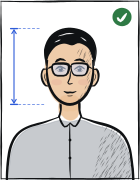
Quick answer: A Japan driver's license photo must be 24 × 30 mm. Even plain background without shadows. Head occupies 55–75% of photo height. Neutral expression, glasses only if no glare. Last verified .
Japan driver's license photo: size in mm, cm, inches and pixels
Millimetres
24 × 30 mm
Centimetres
2.4 × 3 cm
Inches
0.94 × 1.18″
Pixels at 300 dpi
283 × 354 px
Pixels at 600 dpi
567 × 709 px
Japan-specific things to know
There is no single national page — each prefectural police publishes its own — and the pages read agree on 3 × 2.4 cm, bareheaded, frontal, «upper third of the body», no background and six months.
The licence photo itself is usually taken by staff; the paper photo matters for the application, and a photo you bring is accepted only at some centres (the three Tokyo test centres, for renewal, reissue and adding a class) and must be printed on photo paper.
The margin above the head is stated in millimetres — about 3 mm in Tokyo, 2–3 mm in Osaka — and the international driving permit uses a larger photo, 4.5 × 3.5 cm, with about 4 mm above the head.
How driver's license photos are verified
In Japan the driving licence is issued by the prefectural police, and each prefecture publishes its own photo page — the Tokyo Metropolitan Police, the Osaka and the Nara police agree: the application photo is 3 cm high × 2.4 cm wide, bareheaded, frontal, «upper third of the body» (head and the top of the chest) and «with no background», taken within six months before the application, with a small margin above the head — about 3 mm in Tokyo, 2–3 mm in Osaka — and the date and name written on the back (Osaka, Nara). Religious or medical headwear is allowed as long as the outline of the face stays visible (Tokyo, Nara; Osaka accepts a wig, scarf or brimless medical cap on a medical reason). The police list what they reject: a hat, a wide headband or bandana, a face not to the front or a gaze to the side, a face too close or too small in the frame, a face or clothes blending into the background, a patterned wall or curtain, a face too bright or too dark, squinting or closed eyes, hair over the eyes, glasses that reflect or frames over the eyes, dark sunglasses, a wide-open mouth, a mask. The photo on the licence itself is taken by staff under these conditions; in Tokyo you can also use the automatic photo machine at the Fuchu, Samezu or Koto test centre, and a photo you bring (only at those three centres, for renewal, reissue and adding a class) must be printed on photo paper.
Read more
The international driving permit takes a larger photo — 4.5 cm high × 3.5 cm wide, with about 4 mm above the head (Nara).
Examples and mistakes
What makes Japan driver's license photos accepted
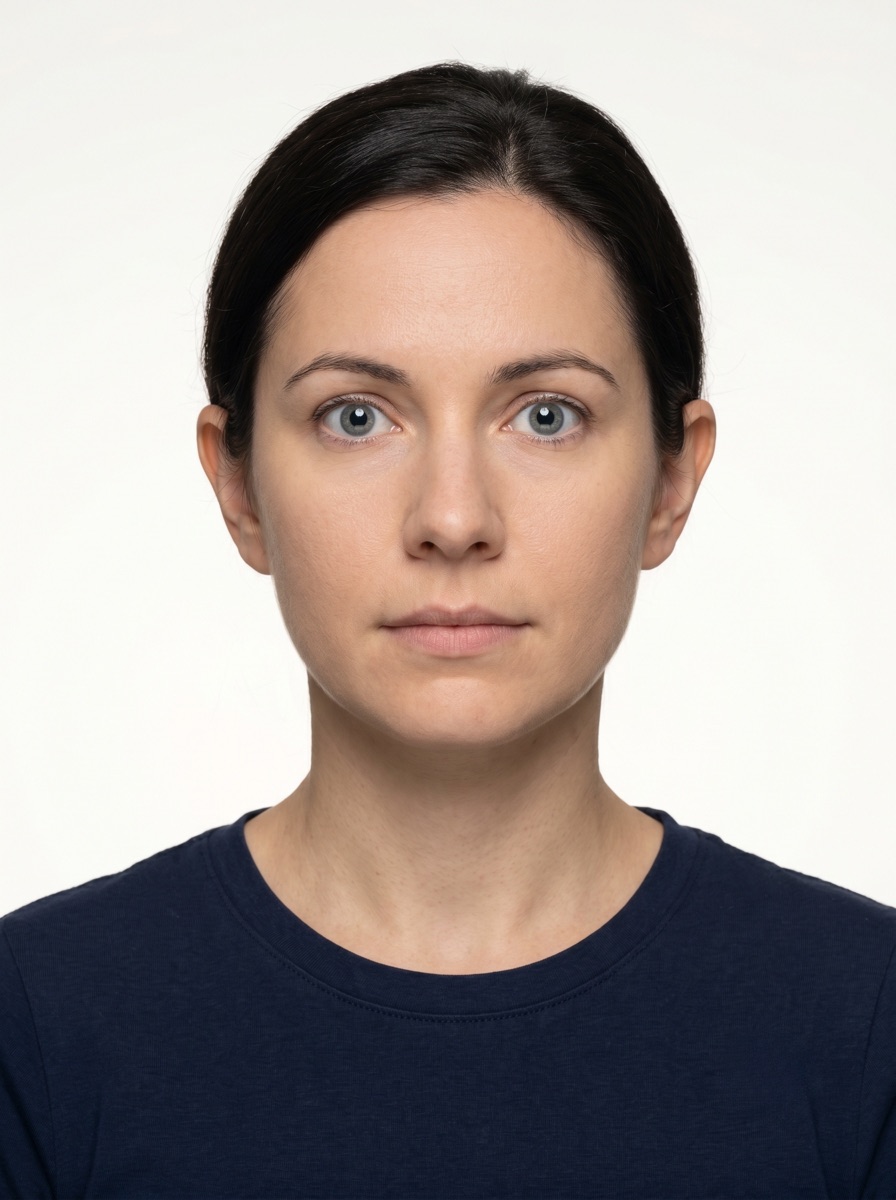
One compliant example next to the six most common rejection causes for Japan driver's license applications. These are the differences that most often determine whether a document photo is accepted.
Accepted
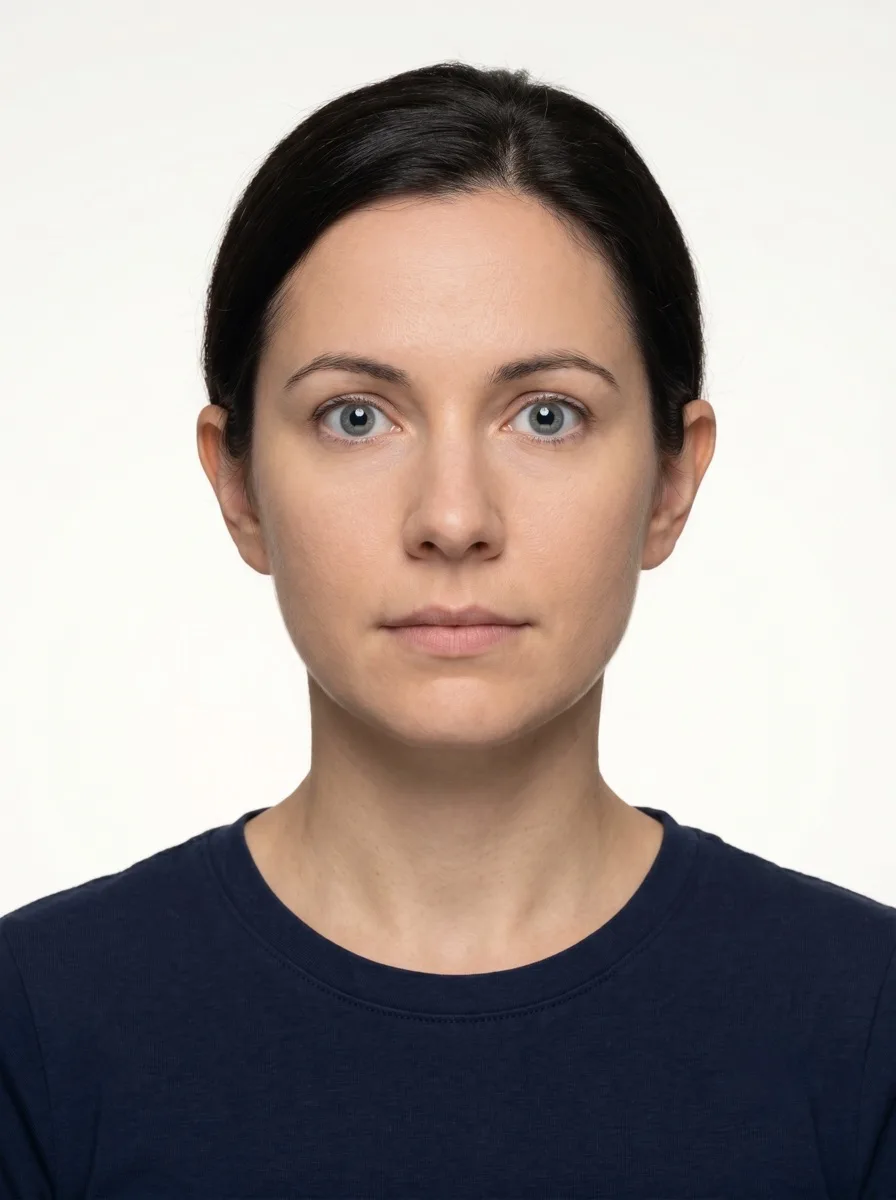
Compliant Japan driver's license example (24 × 30 mm)
Face centred, looking directly into the lens
Plain background — no shadow, pattern or texture
Neutral expression, eyes open, mouth closed
No glasses, no hair across the face
Top 6 Japan driver's license rejection causes
Background shadowShadow on the wall behind the head, or background with a visible pattern or gradient
Smile / open mouthVisible smile with teeth or open mouth instead of a neutral expression
Glasses with glareGlasses with a clearly visible light reflection covering part of the eye
Hair across the faceLoose hair strands covering the eyes, eyebrows or part of the face
Eyes off-cameraEyes looking to the side instead of directly into the camera lens
Head tiltedHead tilted so the eye line is no longer horizontal
Typical rejection reasons and how to fix them
Typical reasons a photo is rejected under the rules Japanese prefectural police (Tokyo Metropolitan Police Department, Osaka and Nara Prefectural Police), driving licence sections publishes: what is wrong and what to change.
Reason
Fix
A hat, a wide headband or bandana, a mask, dark sunglasses, or frames or reflections over the eyes
Bare head (religious or medical cover only with the outline of the face visible), clear glasses without reflection, no mask.
A face or gaze not to the front, a face too close or too small in the frame, or no margin above the head
Frontal, the upper third of the body, a margin of 2–3 mm above the head.
A background with scenery, wallpaper, a curtain or wood grain, or a face and clothes that blend into it
A plain background where the outline of the face and the clothes stand out.
A face too bright or too dark, squinting or closed eyes, hair over the eyes, a wide-open mouth, poor printing
Even light, eyes open and visible, mouth closed or only slightly open, a clean print on photo paper.
How to take your Japan driver's license photo correctly
Background and light
Background: plain, one colour
The tool puts in the required background. Stand half a metre from a plain light wall, face a window and shoot without flash — then there are no shadows on your face or on the wall.
Framing
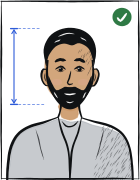
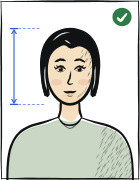
Head: 55–75 % of the photo height
Camera at eye level, about a metre away; head and shoulders in the shot. The tool crops it to 24 × 30 mm.
Glasses
Glasses only if no glare
If you wear glasses, check the shot: no glare on the lenses, eyes clearly visible.
Expression and gaze
Neutral expression, mouth closed, eyes open
Look straight into the lens with your head level; keep hair away from your eyes and eyebrows.
Print at 100% scale, borderless, and turn off fit-to-page so each photo keeps its exact size.
Where to submit your driver's license application
A Japanese driving licence is applied for, renewed or reissued at the driving licence centre or test centre of the prefectural police (in Tokyo Fuchu, Samezu or Koto), with a 3 × 2.4 cm application photo; the photo on the licence is taken by staff.
Prefectural police driving licence centre or test centre (Tokyo: Fuchu, Samezu, Koto)in person; renewals by appointment
The driving licence section of the police of your prefecture (Tokyo: keishicho.metro.tokyo.lg.jp)
Processing
See your prefectural police page
Cost
See your prefectural police page
3 × 2.4 cm, bareheaded, frontal, no background, within six months; the date and name on the back (Osaka, Nara).
Tokyo Metropolitan Police, application and brought photos (translated from the Japanese, updated 17 November 2025): a suitable photograph meets the standard of the Road Traffic Act Enforcement Regulations — 3 cm high × 2.4 cm wide (4.5 × 3.5 cm for the international driving permit); bareheaded (except for religious or medical reasons), frontal, upper third of the body, no background; taken within six months before the application; easy to identify; allowing the licence to be made properly; photos with a cap or cloth for religious or medical reasons are possible within the range that keeps identification easy — consult beforehand.
Tokyo, the licence photo and brought photos: the photo for the licence itself is taken by staff under these conditions; the application photo can be taken in the automatic photo machine at each test centre (Fuchu, Samezu, Koto); photos you bring can be used only at those three centres, only for renewal, reissue and adding a class, and the licence is made from your photo (which takes longer); a class addition needs an application photo as well; nothing printed on other than photo paper is accepted; the date and name on the back are not needed for a brought photo.
Tokyo, unsuitable examples (translated): a hat; a wide headband, bandana or hachimaki covering the head; a face or gaze not to the front; not the upper third of the body — only the face (too close) or a small face (too far); the outline of the face or clothes blending into the background; scenery in the picture; a background of wallpaper, curtain or wood grain; a part of the face cut off; too bright or too dark to see the face; squinting or closed eyes; eyes hidden by hair; glasses that shine so the eyes cannot be seen; frames over the eyes; dark sunglasses; a wide-open mouth; a mask; the face hidden by clothes; poor printing; and no margin (about 3 mm) above the head.
Osaka Prefectural Police, suitable photographs (translated): taken within six months; bareheaded, frontal, upper third of the body, no background; 3 cm high × 2.4 cm wide with 2–3 mm above the head; the date and the name written on the back of the photo; for a medical reason a wig, scarf or brimless medical cap that leaves the outline of the face visible is accepted; the international driving permit has a different size.
Nara Prefectural Police, application photographs (translated, updated 30 June 2026): 3 cm high × 2.4 cm wide, bareheaded, frontal, upper third of the body, no background, taken within six months, with the person sharp; the name and the date of the photo written on the back; for medical or religious reasons medical caps, wigs, scarves and the like are accepted as long as the outline of the face is visible; for the international driving permit 4.5 cm × 3.5 cm, bareheaded, frontal, the face centred, no background, within six months, with about 4 mm above the head.
Questions
Frequently asked questions
3 cm high × 2.4 cm wide, bareheaded, frontal, the upper third of the body, with no background, taken within six months before the application, with a small margin (about 2–3 mm) above the head; religious or medical headwear is allowed if the outline of the face stays visible.
3 cm × 2.4 cm (height × width); the international driving permit takes 4.5 cm × 3.5 cm.
The photo on the licence itself is taken by staff; the application photo can be taken in the automatic photo machine at the Tokyo test centres, and a photo you bring is accepted only at those centres for renewal, reissue and adding a class, printed on photo paper.
No hat; glasses are allowed only if the eyes are visible — frames over the eyes, reflections and dark sunglasses are rejected; religious or medical headwear is accepted if the outline of the face is visible.
The Japan driver's license photo must be 24 × 30 mm. The head must occupy 55–75% of the photo height. The photo is printed on the licence card and must remain recognisable for the full validity period.
Even plain background without shadows. Even, frontal light without shadow gradients. Driving licence printers tend to compress contrast — starting with even lighting prevents underexposed areas from disappearing in the final print.
Eyes must be fully visible without strong reflections. Many authorities specifically allow eyewear when it is required for driving, but the eyes must remain fully visible and there must be no lens glare. Tinted lenses or transition lenses that have darkened are not accepted.
Most authorities require the photo to be taken within the last six months. The licence is typically valid for 5–10 years, so use a recent photo that reflects your everyday appearance — not a one-off styled portrait.
No. Driving licence photos use the same neutral expression standard as biometric passports — closed mouth, eyes open and looking directly at the camera, no raised eyebrows. Smiles distort facial geometry used in modern biometric checks.
Anfas.Pro provides a 14-day full refund if the Japan licence authority rejects the photo and you supply the rejection notice.
24 × 30 mm = 2.4 × 3 cm = 0.94 × 1.18 inches. At 300 dpi that is 283 × 354 pixels; at 600 dpi, 567 × 709 pixels.