 Schengen Area
 Germany
 Netherlands
 Sweden
 Spain
 Belgium
EU residence permit cards: why the Netherlands sets an ear-to-ear face width and Sweden takes the photo itself
There is no single EU standard for residence permit card photos: Regulation 1030/2002 governs the card itself, and national approaches differ.
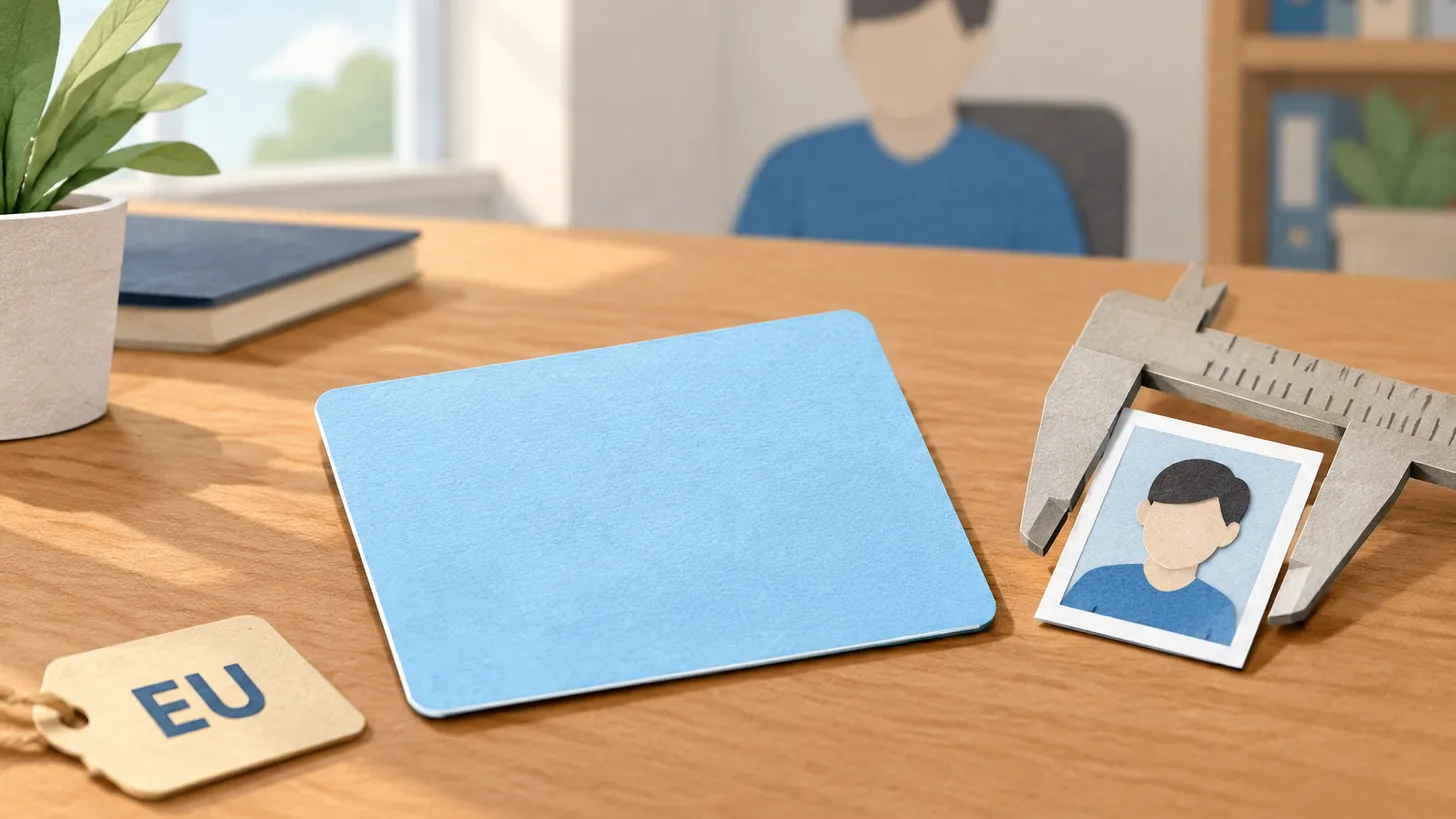
In this article · 8 sections
- 01Residence permit photo requirements compared: the Netherlands, Germany, Sweden
- 02EU Regulation 1030/2002: what is harmonised and what is hidden
- 03National rules: from exact millimetres to digital photo transfer
- 04Why applications are rejected: an analysis of refusals and delays
- 05Step by step: how biometrics are taken in different countries
- 06Sources
- 07Questions
- 08Official sources
Key points
5 points- The EU regulation sets rules for the card material and DOVID protection, but the specifications for the photo may not be published.
- The Netherlands requires a 35x45 mm photo with checks on both face height and face width (16–20 mm).
- Since 1 May 2025, Germany accepts only digital photos for residence documents: they are taken at the authority or at a connected studio and sent through a secure channel.
- Sweden does not reuse old photos: biometrics are taken again for every new card.
- At an IND desk in the Netherlands a staff member takes the photo, while at an embassy the paper photo you bring is scanned.
Short answer
There is no single European format for a residence permit card photo, because Council Regulation (EC) No 1030/2002 governs the card itself. This EU-wide instrument sets the card's basic technical parameters: the ID-1 format (the regulation allows ID 1 or ID 2), polycarbonate or an equivalent synthetic polymer with a service life of at least 10 years, a diffractive security feature (DOVID) over the portrait, and laser engraving. Requirements for facial image quality are set out in technical specifications that may be classified as secret and not published.
In practice, the countries reviewed apply their own national standards to photo dimensions and to how the photo is supplied. The Netherlands requires a 35x45 mm file with a head window of 26 to 30 mm for people over 11 and a face width of 16 to 20 mm. In Germany the basic frame size is 35x45 mm with a head height of 32–36 mm. Since 1 May 2025, these photos have been taken only in digital form in Germany.
The approach to reusing biometrics varies. In Sweden you must be photographed again for every new card; data is not kept between applications. In the Netherlands, the IND reuses biometrics if they were provided less than six months earlier. In this verified database of 241 document profiles, 229 specify a print size. The most common size is 35x45 mm (148 profiles). Database figures as of 22 Sep 2026, the date of this article.
Residence permit photo requirements compared: the Netherlands, Germany, Sweden
Because the EU regulation does not set any public millimetre values, photo parameters depend on the country where the application is made. We checked the parameters of three countries that take different approaches to biometrics.
| Parameter | Netherlands (IND / Government) | Germany (AufenthV / Service Berlin) | Sweden (Migrationsverket) |
|---|---|---|---|
| Physical size | 35 × 45 mm | 35 × 45 mm | 35 × 45 mm |
| Head height (chin to crown) | 26–30 mm (age 11 and over); 19–30 mm (up to 10) | 32–36 mm (71–80% of the frame) | 70–80% of the frame |
| Face width (ear to ear) | 16–20 mm | Not published by the authority | Not published by the authority |
| Maximum age of photo | No older than 6 months | Current photo | Taken anew every time |
| Permitted background | Light grey, light blue or white | Light, plain background | Neutral, light, plain background without shadows |
Europe SchengenResidence Card · requirements · check a photo
GermanyResidence Permit · requirements · check a photo
NetherlandsResidence Card · requirements · check a photo
SwedenResidence Card · requirements · check a photo
EU Regulation 1030/2002: what is harmonised and what is hidden
The foundation for all residence permit cards in the European Union is Council Regulation (EC) No 1030/2002 laying down a uniform format for residence permits for third-country nationals, consolidated to include later amendments. It sets the physical characteristics of the plastic card itself, but the requirements for facial image quality are set out in technical specifications.
Under the regulation, residence permits must be issued as stand-alone documents in ID-1 or ID-2 format, based on the specifications of ICAO Doc 9303, 7th edition, 2015. The card must be made entirely of polycarbonate or an equivalent synthetic polymer with a service life of at least 10 years. The photograph, like other biographical data including the holder's signature, is integrated into the core material of the document. This personalisation is carried out using laser engraving or another equally secure technology.
An identity photograph shall be securely integrated into the card body and secured by a diffractive optically variable image device (DOVID).
The regulation pays particular attention to optical security: the photograph must be securely embedded in the card body and protected by a diffractive optically variable image device (DOVID); a separate DOVID is provided to protect the portrait.
The regulation itself, however, contains neither millimetre frame widths nor percentages for how much of the area the face should fill. Article 2(1)(e) states that quality requirements and common standards for the facial image and fingerprints are adopted as additional technical specifications. Under the procedure in Article 7(2), these specifications may be declared secret and not published.
National rules: from exact millimetres to digital photo transfer
With no public EU-wide millimetre standards, applicants have to rely on the rules of their country of residence. In this verified database of 241 document profiles, 52 set the background as white, 23 name a specific non-white shade, and the rest require a light background without fixing an exact colour. Figures as of 22 Sep 2026.
The Netherlands: millimetre precision and two application routes
The Immigration and Naturalisation Service (IND) refers to the same requirements that apply to Dutch passports, published on rijksoverheid.nl. The photo must have a fixed format of 35 × 45 mm. The digital file must have a resolution of at least 400 dpi, and the photo must be no older than 6 months at the time of application.
The Netherlands sets the face height from chin to crown: from age 11, a minimum of 26 mm and a maximum of 30 mm; up to and including age 10, a minimum of 19 mm and a maximum of 30 mm. The face width, from the point where one ear attaches to the other, is 16 mm to 20 mm. The ears themselves need not be visible as long as the width of the face can be seen. Background: light grey, light blue or white; even, single-coloured, without a gradient, and with sufficient contrast between the head and the background.
Headwear is allowed for religious or philosophical reasons. It must be a single colour and contrast with the background. If you need to prepare a correct digital or print file before applying, you can make an EU residence permit card photo online with our system.
Germany: a reference to passport rules and fixed fees
In Germany, photo requirements are set out in § 60(1) of the Residence Ordinance (AufenthV) by reference to § 4 of the Passport Ordinance of 19 October 2007; the foreign national must be clearly recognisable from the photo, and the face and head must not be covered.
The competent authority may permit OR prescribe exceptions regarding headwear if identity can still be sufficiently established. The applicant's obligation in Germany is, at the authority's request, to provide a current photo OR to take part in having it made. The photo may only be altered in the manner provided for by the Residence Act or the ordinance itself. The authority stores the photo for inclusion in the document and for later comparison with the actual appearance of the document holder.
German fees for a residence permit card are set out in § 45 AufenthV. Issuing an Aufenthaltserlaubnis, Blaue Karte EU or ICT card costs 100 euros. An extension of up to three months costs 96 euros, and of more than three months 93 euros. A change of purpose of stay together with an extension costs 98 euros. Issuing a Mobiler-ICT-Karte costs 80 euros, and extending it 70 euros.
Since 1 May 2025, biometric photos for residence documents must be created digitally at government offices or by connected photo studios/shops that send them through a secure channel.
Sweden: no reuse and the status of the card
In Sweden (Migrationsverket), biometrics are not reused. Data is not kept between applications. You must be photographed and give fingerprints again every time you need a new card, including when extending your permit.
The Swedish residence permit card is valid for as long as the permit, but for no more than three years. The card is not considered an official identity document or a travel document, and it cannot be used to prove your identity.
Why applications are rejected: an analysis of refusals and delays
Even though the plastic card is standardised, applications are often held up precisely because of the photos. An analysis of official guidance from the authorities points to several structural reasons why photos are rejected.
- Relying on the myth of a “single European format”. Regulation 1030/2002 governs the card, not the photo. The EU's technical specifications for facial image quality may be classified and not published, so there is no single photo format for a residence permit card.
- Ignoring the second face dimension in the Netherlands. The Dutch standard sets not only the height of the face but also its width: 16–20 mm from ear attachment point to ear attachment point. This is a second dimension, independent of height, on which a photo can be rejected even when the head height is formally correct. The IND states the consequence plainly:
Een foto die niet aan de vereisten voldoet, levert onnodige vertraging op.
(A photo that does not meet the requirements causes unnecessary delay.) - Mistakes about reusing biometrics. The reuse models differ fundamentally. The Swedish authority photographs the person from scratch every time. The IND reuses biometrics if they were provided less than 6 months earlier.
- Different media depending on the application route. In the Netherlands, the same route yields two different media: at an embassy, a staff member scans the paper photo you bring; at an IND desk, the staff member takes the photo. Applicants learn this only from annex 7102, which does not need to be sent with the application.
- Misreading the headwear rules. The German wording on headwear cuts both ways: the authority may “permit OR PRESCRIBE” an exception, meaning it can require headwear to be removed or require it to be worn if identity cannot otherwise be established.
Step by step: how biometrics are taken in different countries
The procedure for photographs and fingerprints is tied closely to where you apply. Here is how the process works under national rules.
- Determining how the photo is obtained. In Sweden, photos are taken at the authority or at a mission abroad. For children under 2, the IND requires a submitted photo taken by a photographer; at an IND desk, a staff member takes the photo. In Germany, since 1 May 2025, the photo is created by the authority or a connected photo studio and sent through a secure channel.
- Providing biometrics and returning the old card. A Swedish card is issued only with fresh biometrics: the photo and fingerprints are taken at every issue. The old residence permit card must be returned when you collect the new one. In the Netherlands, the IND reuses existing biometrics if the applicant provided them less than 6 months earlier at an IND desk or at an embassy abroad.
- Paying the fees. In Germany, issuing an Aufenthaltserlaubnis, Blaue Karte EU or ICT card costs 100 euros (§ 45 AufenthV). Extending it for up to three months costs 96 euros, and for longer 93 euros.
- Waiting for production and delivery. In Sweden, if the photo is taken at an embassy or consulate general, delivery to the mission takes up to four weeks; if it is taken at Statens servicecenter, the card arrives at your home address within two weeks.
Sources
This article is based on official European Union regulations and national legislation of the member states. All data was current at the time of the last check.
- Council Regulation (EC) No 1030/2002 laying down a uniform format for residence permits (consolidated text) — EUR-Lex (Council of the European Union) (checked 22 Sep 2026).
- § 60 of the German Residence Ordinance (AufenthV) — Bundesamt für Justiz (checked 22 Sep 2026).
- § 45 of the German Residence Ordinance (residence permit fees) — Bundesamt für Justiz (checked 22 Sep 2026).
- Photo requirements (Eisen aan de pasfoto) — Rijksoverheid (Government of the Netherlands) (checked 22 Sep 2026).
- Form 7102 “Vingerafdrukken, pasfoto en handtekening” — IND (Netherlands) (checked 22 Sep 2026).
- Explanation of the residence permit card (Uppehållstillståndskort) — Migrationsverket (Sweden) (checked 22 Sep 2026).
- Requirements for issuing documents — Service Berlin (checked 22 Sep 2026).
07Questions
6 answers01Can I reuse an old photo when renewing my residence permit card?
It depends on the country. In the Netherlands, the IND reuses biometrics if they were provided less than 6 months earlier. In Sweden, old data is not kept, so the photo and fingerprints are taken again for every new card.
02Is the Swedish residence permit card an identity document?
No. Migrationsverket states explicitly that the card cannot be used to prove your identity and is not valid as a travel document.
03What are the fees for a residence permit card in Germany?
Under § 45 AufenthV, issuing an Aufenthaltserlaubnis costs 100 euros. An extension of up to three months costs 96 euros, and of more than three months 93 euros.
04Why does the EU regulation not give face dimensions in millimetres?
Regulation 1030/2002 places image quality requirements in separate technical specifications (Art. 2). The regulation explicitly allows these specifications to be classified and not published.
05Do I need to bring a printed photo when I apply?
In Sweden, photos are taken at the authority or at a mission abroad. At an IND desk in the Netherlands, the staff member takes the photo, while at an embassy the staff member scans the photo the applicant brings.
06What are the exact face dimensions for a Dutch card?
From age 11, the face from chin to crown must measure 26–30 mm; for children up to and including age 10, 19–30 mm. The face width between the ear attachment points is 16–20 mm.
08Official sources
- Council Regulation (EC) No 1030/2002 laying down a uniform format for residence permits (consolidated text)
eur-lex.europa.eu - § 60 of the German Residence Ordinance (AufenthV)
gesetze-im-internet.de - § 45 of the German Residence Ordinance (residence permit fees)
gesetze-im-internet.de - Photo requirements (Eisen aan de pasfoto)
rijksoverheid.nl - Form 7102 “Vingerafdrukken, pasfoto en handtekening” – fingerprints, passport photo and signature
ind.nl - Explanation of the residence permit card (Uppehållstillståndskort)
migrationsverket.se - Requirements for issuing documents
service.berlin.de
Author: Yevhen Kravchenko. Published . Checked against official sources on .
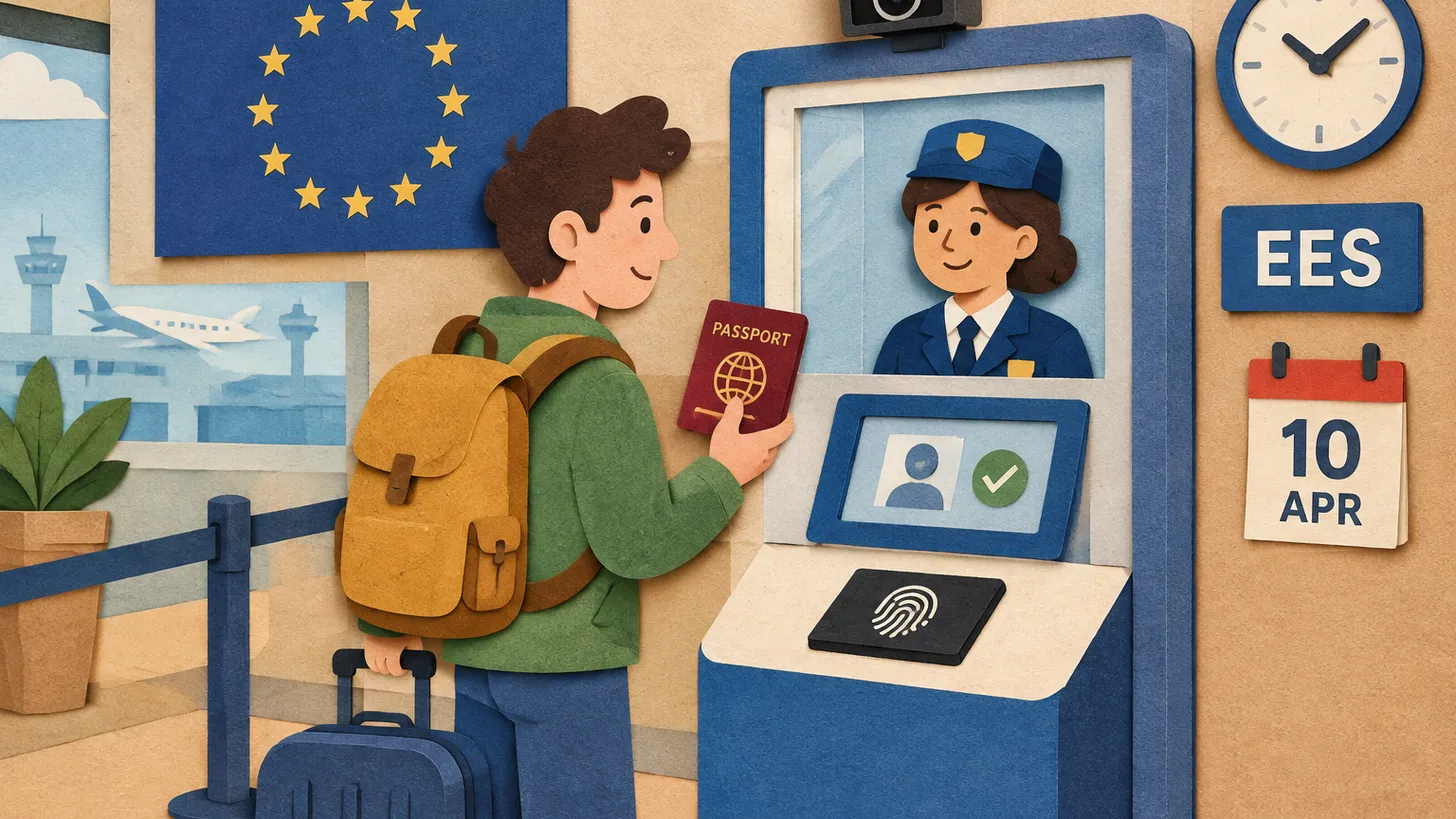
Schengen AreaEES Is Live: The Face Photo and Fingerprints Taken at the Schengen Border
Since 10 April 2026 the EES records a face photo and fingerprints of non-EU short-stay visitors at all Schengen external borders — no advance registration.
 Poland
 United KingdomNetherlands+3
Residence permit photo rejections: why a file fails the 684×883 px limit, and the voivode's summons
If the system did not reject the photo automatically, the voivode summons the applicant to provide a suitable photo; if the summons is ignored, the application will be left unexamined.
 SpainNetherlandsSweden+2
Reused Biometrics or a New Photo for a Residence Permit Renewal: Rules in Spain, the Netherlands and Sweden
Rules for renewing a residence permit vary: the Netherlands may not require new biometrics if they were taken less than 6 months ago, while Sweden requires a new capture for every new card and Italy asks for 4 photos when you are called to the Questura.

Make the photo for this document
Upload a selfie — we crop it to 35 × 45 mm, replace the background and check it against the document rules. Free preview.
Residence Card · Europe SchengenUpload