China visa photo rejected — visa centre reasons and how to fix each
Chinese visa photo requirements are published by the Chinese Visa Application Service Center: a 33 × 48 mm portrait on a plain white background, with the head 28-33 mm from chin to crown and 15-22 mm wide and a closed mouth. The visa itself is issued by the embassy or consulate, and a photo that misses the published specification is turned back before the rest of the application is read. This guide covers the six common reasons applications are rejected.
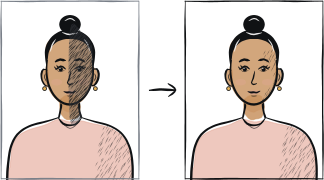
Fast diagnosis
Key checks: ears not visible, expression, background not white
The three common China visa photo rejections are: ears hidden behind hair, a non-neutral expression, and a background that is not plain white — the blue and red backgrounds used for Chinese domestic ID documents do not work for a visa photo.
6 common rejection checks
Ears not visible
Both ears need to be visible in the frame. Hair tucked behind the ears, or short hair, is the fix.
Smile or non-neutral expression
The mouth must be closed and the expression neutral, with the head turned no more than 20 degrees and tilted no more than 25 degrees from straight.
Background not white
The visa centre requires a plain white background. Blue and red backgrounds used for Chinese domestic ID documents are not accepted for a visa photo, and neither is a grey or cream wall.
Eyebrows covered by hair
Eyebrows must be fully visible. Hair across the forehead is a top rejection cause.
White clothing on a white background
The visa centre asks applicants to wear a coloured or dark top. A white shirt merges with the white background and the outline of the shoulders disappears, which is a stated reason to refuse the photo.
Photo older than six months
The visa centre asks for a colour photo taken within the last six months. An older print is refused at submission even when your appearance has not changed.
5-step recovery checklist
Tuck hair behind both ears; pull fringe away from eyebrows.
Wear a coloured or dark top and stand against a plain white wall under window daylight.
Neutral expression, mouth closed, eyes open and looking forward.
Use our tool to crop to 33 × 48 mm with the head 28-33 mm from chin to crown and 15-22 mm wide.
Use a photo taken within the last six months — an older print is refused even when your appearance has not changed.
Frequently asked questions
01Can I wear glasses in a Chinese visa photo?
Yes — unlike the US and Canada, the Chinese visa photo does allow glasses. What is not allowed is a thick frame, a tinted lens or any reflection across the eyes. If your frames are wide or your lenses catch the light, take them off for the shot rather than risk it.
02Can I wear earrings in a Chinese visa photo?
The published requirements do not mention jewellery. What they do require is that both ears are visible and the face is unobstructed, so anything large enough to cover an ear — a drop earring, a wide hoop — is the real risk. Small studs do not usually get in the way.
03What about a religious head covering?
A religious head covering such as a hijab or turban is accepted when the facial outline stays fully visible. A fashion head covering is not accepted, and the print itself has to be on glossy photo paper with no border and nothing stapled through it.
Other rejection guides




Show all 33Collapse


















Reshoot in 2 minutes
Upload a fresh portrait — Anfas.Pro applies the correct crop, background and biometric framing automatically and shows the result before you pay.