Turkey passport photo rejected — NVI reasons and how to fix each
Turkey's biometric photo standard, published by the NVI (Nüfus ve Vatandaşlık İşleri), calls for an unusually large 50 × 60 mm print — bigger than the 35 × 45 mm size used by Japan, South Korea and the Schengen states — on a plain white background, taken within the last 6 months. Unlike most passport authorities, the NVI does not publish an exact head-height ratio, so many rejections come from framing that looks fine on screen but does not match the officially centred, full-hairstyle composition.
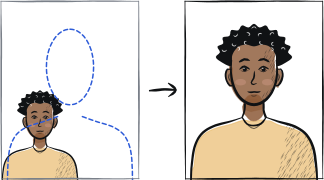
Fast diagnosis
Key checks: wrong print size, background not plain white, sunglasses or tinted lenses
Common checks include a print at a size other than 50 × 60 mm — a size most photo studios outside Turkey do not have preset — a background that is not plain white, and sunglasses or tinted lenses, which are explicitly banned even though clear prescription glasses are allowed.
7 common rejection checks
Wrong print size (not 50 × 60 mm)
Turkey's biometric photo is 50 × 60 mm — noticeably larger than the 35 × 45 mm standard used by Japan, South Korea and the Schengen states. Many photo studios and printers outside Turkey do not have this size preset and default to the more common format. The NVI warns that a photo at the wrong size or on the wrong background either stops the application from being completed or fails quality control after submission, in which case the card is cancelled and you apply again — so tell the studio explicitly not to trim the print down to 35 × 45 mm.
Background not plain white
The NVI specification calls for a plain white background with no pattern. A tinted, textured or shadowed background is rejected even when the rest of the photo is compliant.
Sunglasses or tinted lenses
Tinted lenses and sunglasses are explicitly not allowed. Clear prescription glasses are permitted only if they are necessary and the frame does not obstruct the eyes — otherwise remove them for the shot.
Photo older than 6 months
The official rule requires a photo taken within the last 6 months. An older photo is rejected even if your appearance has not changed.
Face not centred or hairstyle cropped out
The NVI states the face must be centred in the photo with the hairstyle fully visible. Unlike most passport authorities, Turkey does not publish an exact head-height ratio — frame a wider portrait and let a tool fit it to the 50 × 60 mm print rather than cropping tightly by eye.
Shadows, reflections or red-eye
Lighting must fall evenly on the face with no reflections, shadows or red-eye. Indoor flash pointed straight at the face is a common cause of exactly this problem.
Damaged, creased or stained print
The specification explicitly rejects prints with spots, creases or wrinkles. Print on quality photo paper and keep it flat until your appointment.
5-step recovery checklist
Print or export at exactly 50 × 60 mm — it is larger than the common EU format.
Shoot against a plain white wall with even daylight, with no pattern or tint in the background.
Remove sunglasses and tinted lenses; keep clear prescription glasses only if necessary, with the frame clear of your eyes.
Reshoot within the last few weeks rather than reusing an older photo — the limit is 6 months.
Frame a wider portrait and let the tool centre the face and fit the 50 × 60 mm print, since Turkey does not publish an exact head-height ratio to crop against.
Frequently asked questions
01Why is the Turkish passport photo size so unusual?
At 50 × 60 mm, Turkey's biometric photo is noticeably larger than the 35 × 45 mm standard used by Japan, South Korea and the Schengen states. Because the size is uncommon outside Turkey, photo studios and printers abroad often default to the wrong preset.
02Can I wear glasses in a Turkish passport photo?
Clear prescription glasses are allowed only if you need them and the frame does not cover your eyes. Tinted lenses and sunglasses are explicitly not permitted, regardless of the reason.
03Does Turkey have an exact head-size rule like other countries?
No published exact ratio — the NVI specification only states that the face must be centred with the hairstyle fully visible, unlike authorities such as Japan that publish a precise head-height range. That does not make framing optional: a photo that is off-centre or crops out part of the hairstyle is still rejected on sight.
Other rejection guides
Show all 33Collapse




Official sources
Verified .
Reshoot in 2 minutes
Upload a fresh portrait — Anfas.Pro applies the correct crop, background and biometric framing automatically and shows the result before you pay.