Germany passport photo rejected — Bürgeramt reasons and how to fix each
Since 1 May 2025 a German passport application no longer accepts a printed photo at all. The Bürgeramt takes the picture on a PointID terminal for a flat fee of €6, or a registered photo studio sends it to the authority through a certified encrypted cloud and hands you a printout with a Data-Matrix code. Self-made photos, passport-app exports and any print — even a perfect one — are refused, and the transition period that allowed exceptions ended on 31 July 2025. The one exception is an application filed at a German mission abroad, where a paper 45 × 35 mm photo is still accepted.
Fast diagnosis
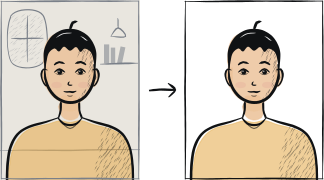
Key checks: paper photo, missing Data-Matrix code, face size in frame
The three things that send people home from a German passport appointment are: bringing a printed photo, which the office is no longer allowed to accept; arriving from a studio without the Data-Matrix code printout that lets the clerk retrieve the file; and a face that does not fill 70-80% of the picture height. The rule change exists to rule out morphing — an image blended from two faces.
7 common rejection checks
Bringing a printed photo to the appointment
Since 1 May 2025 the photo has to reach the authority digitally. A print is refused whatever its quality, and the transition period that let offices accept one in exceptional cases ended on 31 July 2025. Book the shot at the office itself or at a studio connected to the certified cloud.
No Data-Matrix code from the studio
If you do not have the picture taken at the office, a registered studio transmits it through the certified encrypted cloud and gives you a printout carrying a Data-Matrix code. Without that code there is nothing for the clerk to retrieve, so ask for it before you leave the studio.
Face not filling 70-80% of the photo height
The published rule is that the face occupies 70 to 80 per cent of the picture height, measured from the tip of the chin to the top of the head, with both halves of the face clearly visible. Below that range the face is too small to measure; above it the crown gets cut.
Background does not contrast with hair
The rule is contrast, not a particular shade: the background must be a single light, neutral colour that clearly separates both your face and your hair from it. Fair or grey hair against a white wall is the common failure — a light grey backdrop solves it.
Glasses reflecting or covering the eyes
Germany does allow glasses — the rule is that reflections must not appear and the frames must not cover the eyes. Thick frames, tinted lenses and any glare across the lens are what fail; if you cannot avoid a reflection, take them off.
Expression not neutral
The requirement is a neutral, front-facing expression with no grimace. There is one documented exception: a long-term or permanent medical condition — facial paralysis, asymmetry, or an inability to hold the mouth closed at rest — is accepted with evidence.
Head covering worn without a religious reason
A head covering is accepted only on religious grounds, and even then the face must stay fully visible from the chin to the hairline.
5-step recovery checklist
Check whether your Bürgeramt has a PointID terminal — call ahead or look at its website. The photo taken there costs a flat €6.
If it does not, use a registered photo studio that transmits through the certified cloud, and leave with the printout carrying the Data-Matrix code.
Keep glasses on only if there is no reflection and the frames do not cover your eyes; otherwise take them off.
Keep a neutral, front-facing expression and choose a background that separates both your face and your hair from it.
Applying at a German mission abroad? There a paper photo of 45 × 35 mm is still accepted — use our tool to produce that print.
Frequently asked questions
01Can I still bring a printed photo to my German passport appointment?
Not for an application filed inside Germany. Since 1 May 2025 the photo must reach the authority digitally — taken at the office on a PointID terminal for €6, or sent by a registered studio through a certified encrypted cloud, with a Data-Matrix code printout handed to you. The transition period ended on 31 July 2025. Applications filed at a German mission abroad still take a paper 45 × 35 mm photo.
02What is the Fotomustertafel?
The Fotomustertafel is the Federal Ministry of the Interior's sample chart (item BMI24037, July 2025 edition) showing accepted and refused biometric photos side by side. A separate document, the Lichtbild-Schablone, is the measuring template with the eye line and head height, published in one version for people aged 10 and over and another for children aged 6 to 9.
03Why is the German check stricter than in other Schengen countries?
Because a passport is not a visa. Schengen visa photos follow the EU Visa Code, while a German passport follows the national Passverordnung and the BSI technical directive TR-03121 on biometrics in official applications — and since May 2025 the photo must reach the authority digitally. The same shot can be accepted for a French visa and refused for a German passport.
Other rejection guides

Show all 33Collapse









Reshoot in 2 minutes
Upload a fresh portrait — Anfas.Pro applies the correct crop, background and biometric framing automatically and shows the result before you pay.